Most organizations have never mapped their own value chain. They know their departments, track KPIs, keep org charts up to date. But a picture of how activities depend on each other, from what the customer needs all the way down to the invisible pieces that make it work, doesn't exist.
Without that picture, AI decisions are guesswork. You automate whatever is in front of you, invest where the vendor is loudest, cut where the savings show up fastest. Licenses get distributed, workflows get built, and nobody knows where value was actually moving.
The map
Simon Wardley spent twenty years building a method for this. You start with the user and what they need. Break that need into the activities required to deliver it. Draw the dependencies.
The vertical axis is how visible each activity is to the user: at the top, what they interact with directly; at the bottom, what they rely on without knowing it. The horizontal axis tracks how each activity evolves through four stages: genesis (someone invents it, no market yet), custom-built (tailored, expensive, understood by few), product (you can buy it, compare options, switch providers), commodity (standardized, interchangeable, invisible, like electricity). Competition pushes everything rightward along this axis, and no single organization can stop it while others keep competing on the same activity.
Every component lands somewhere on this map. Its position tells you how mature it is, how visible, and where it's headed.
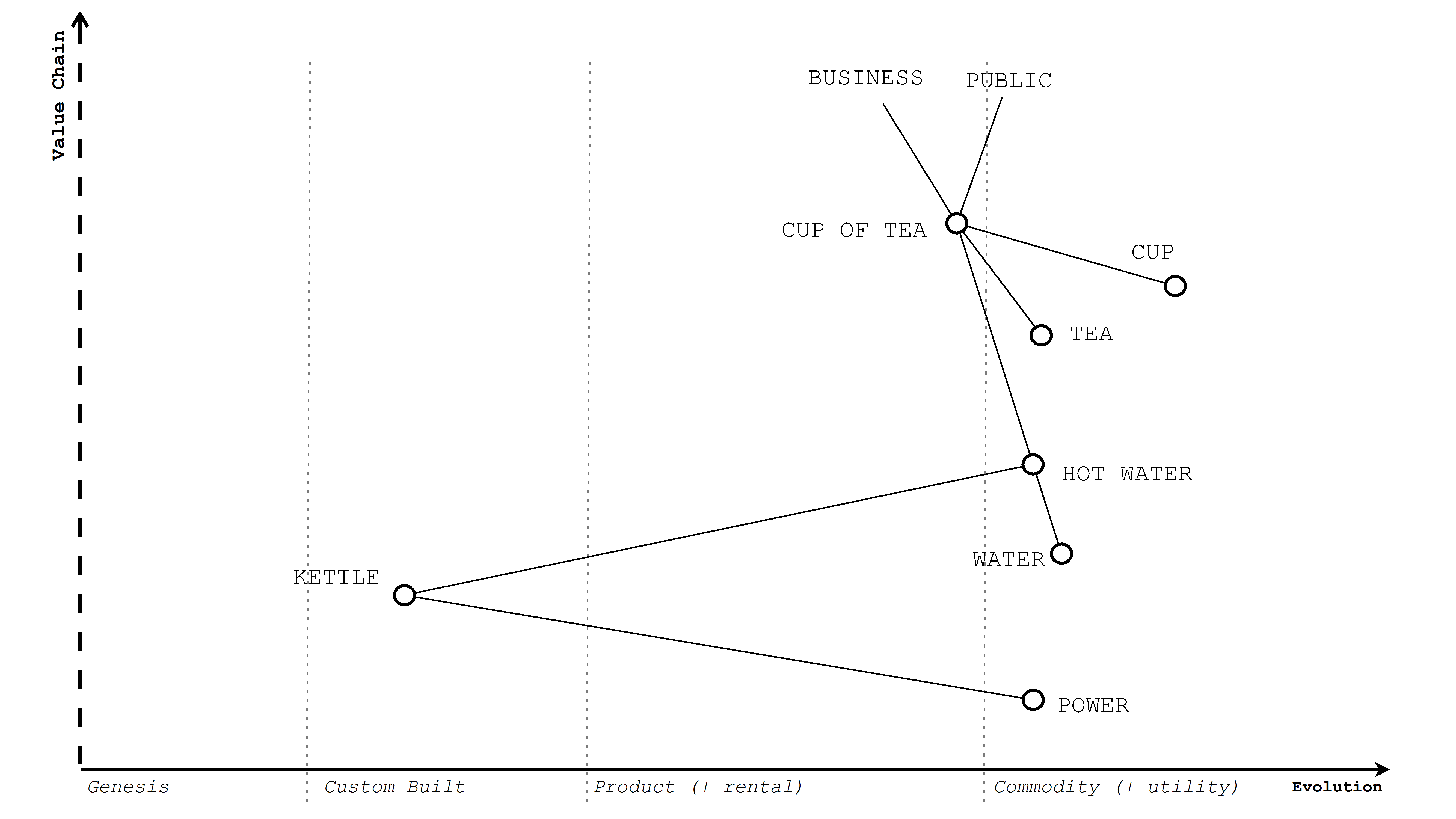
The shift
Sangeet Paul Choudary splits value into three layers. Intrinsic value is the skill itself, the sophistication behind doing something well. Economic value is what the market pays for it, which tracks scarcity. Contextual value is how much that skill matters in the specific situation where it's applied, for that client, at that moment.
When AI can replicate a skill at near-zero marginal cost, the scarcity propping up its economic value collapses. The underlying need doesn't vanish. It migrates. Abundance in one skill creates scarcity in whatever sits next to it. Cheap information makes interpretation expensive. Cheap execution makes judgment expensive.
Overlay these three layers on the map, component by component, and three moves come into focus.
Automate what's becoming commodity. Every hour you spend doing standardized work by hand is an hour pulled away from where value is pooling. Make commodity components reliable and invisible so the rest of the chain can breathe.
Double down where human judgment matters more. As AI handles execution, value migrates toward the calls it can't make: high-stakes decisions where the cost of being wrong is lopsided, trust-sensitive moments where the client needs a person standing behind the answer, and ambiguous situations where the data points in different directions and someone has to read the room. The people holding those decisions are where your investment compounds.
Look for what the old constraints made impossible. When a scarcity-based bottleneck disappears, new combinations of skills and resources open up that the previous system couldn't support. If analysis gets cheap, you can deliver strategic intelligence to organizations that were priced out. If AI can handle coordination across messy boundaries, you can run ecosystems that used to require years of shared standards and dedicated infrastructure. This is the hardest move to spot because it means imagining something the old system never allowed.
An AI-ready organization can answer two questions: where are the constraints shifting in its value chain, and is the structure keeping up.